Business + Brand Strategies = Enterprise Culture
No air between them..one holistic strategy is the only way enterprise thrives
the Persistent Problem
“While 84% of leaders say long-term brand building is very important to business success, only 36% believe their orgs are effective at it.”
Does your brand promise innovation but your business incentivizes efficiency?
Does your brand celebrate customer-centricity but your business skips employee training on how to?
Does your brand or business strategy promote direct customer-employee relationship building? at least a sense of it...as an everyday or frequent experience?
How can anyone care about what they can’t see-hear-feel?
your Brand Strategy IS your Business Strategy
This is where most stumble.
They develop a brand strategy in isolation, then expect it to somehow magically permeate the organization. Not.
“This is the fundamental mistake: treating brand building as a marketing function instead of an org-wide structural imperative.”
As a customer...if they’re not aligned...you feel it one way or another.
As an employee...if they’re not aligned...the same.
Although a customer might be drawn to your awesome looking-sounding brand presentation...if your business strategy doesn’t support it, effectively...you're just wasting time on expensive fiction. Conversely, a sound business plan without a values-resonant or relationship-sparking call to action is simply energy spent without purpose.
Long-term brand building doesn’t fail because companies lack vision or creativity. It fails because business and brand are not truly aligned and alignment requires discipline.
Without that discipline, even the best brand strategy remains inert.
Brand is not what we say, it’s what we repeatedly do.
Both business-brand strategies must support the existence of each other plus be operationalized within each other as they, ultimately, manifest or reflect things like:
employee vibe
how product teams render decisions
how customer service teams solve problems
the tone your CEO sets in meetings, events, in the press, and one on one.
If both strategies aren’t optimized in relation to each other you’re victim to a one-way cliff dive...instead of stewarding a low-friction, regenerative loop of synergy-productivity.
Brand-Business Integration IS Culture Building
The combination of your Business and Brand Strategies is exactly what manifests your Culture:
your Culture’s Body
…operational-tactical-practical-tangible-substance is the Businessyour Culture’s Soul
…values-relationship-psychological-emotional-intangible-style is the Brand.
Business and Brand Strategies must work as integrated partners...for the fundamental reason that their union or dissociation manifests your Culture. As discussed above, either your employees or customers are more than aware of a bumpy ride...hoodwink coverup.
This is the Operationalization Challenge. Brand Equity doesn't build itself. It requires deliberate, coordinated effort across every function. It means your product packaging transmits the same brand story your customer service rep interactions do...and as your leadership team’s style does.
Your Brand-Business-Culture must run on, plus manifest, the Same Story. Story is still what motivates us all...employees and customers alike. It must be resonant in every effort. If your Business-Brand Stories have conflicting protagonists or plots...no one is gleaning any pattern-theme-purpose. No points.
And Human Cultures thrive exactly how Nature Cultures do...holistically.
In any Natural holistic entity...all the diverse parts are in conscious relationship with each other...inherently collaborative not competitive...these different roles all, actually, originate from the same encoded DNA instructions embossed at a cellular level.
Their Purpose as a part, is motivated by their sense of innate relationship to the greater Whole.
Operationalizing Culture by Way of Business-Brand Strategies
Since a brand cannot live only in positioning decks or campaigns it has to be reinforced daily through behaviors, leadership decisions, and operational choices.
But conceiving of an org-integral brand-business building platform and, actually, implementing it are two very different things...and too often why brand promises fall flat for both internal and external audiences.
That consistency-continuity requires high-stakes choices...uncomfortable at times:
Metrics must include emotional health alongside financial performance
Hiring decisions must consider cultural fit with brand values
Product roadmaps must reflect brand positioning
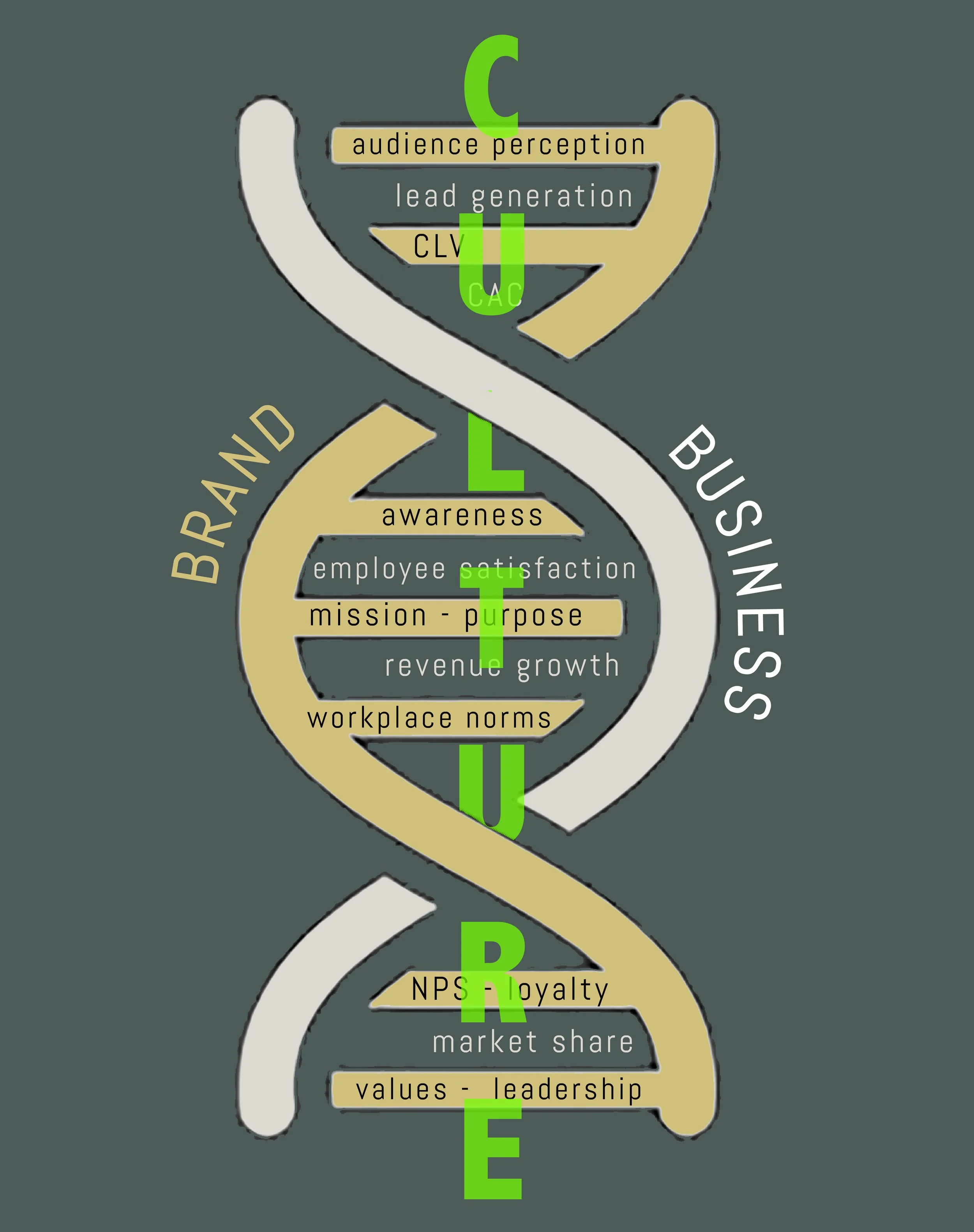
Therefore, operationalizing brand strategy requires translating it into decision frameworks teams can use.
Premium Quality as a concept doesn’t help procurement when they’re choosing suppliers. Does Premium mean +15% cost is acceptable? Or would it be +5%?
Without this clarity, teams default to price and brand erodes.
The 36% who succeed...are building explicit frameworks that afford team clarity for making business-brand consistent decisions...without constant escalation or protraction.
Brand becomes Business Strategy when it shapes how ALL enterprise-org decisions are made.
The strongest brands don’t just say what they stand for...they live it through every team, decision, and customer interaction.
So when your brand...the values-infused and relationship-building mechanism of your enterprise...stops being thought of as simply a communication exercise...and, instead, is elevated to permeate the entire org’s way of treating each other...your business and brand are aligned, such that a cohesive, fully functioning, and vibrant culture can emerge.
Summary
The questions must always be:
What’s good for the Brand-Business-Culture?
How do we Operationalize what We Want to Stand for?
At orgs that get this right, the brand isn't a separate thing to manage...brand is the organizing principle for how the business operates.
What separates the 36% who are effective at long-term brand building from everyone else? Here’s what Denise Yohn says:
Stop treating your brand as a marketing artifact...start using it as the embodiment of your organizational purpose and culture.
Look at your team incentives...do they reward long-term brand equity building or just short-term revenue growth?
Examine your culture honestly...does it support your brand identity or undermine it? Where are the disconnects?
Most importantly, recognize that brand building is an operational challenge not a creative one.
The question isn't: ‘What should our brand be?’ It's ‘What do we want to stand for? And how do we operationalize that across every aspect of our business?’
This is the work that defines any org’s success. And for those willing to do it, the rewards aren't just realized in brand equity...they show up in revenue growth, customer loyalty, employee satisfaction, and long-term resilience.
ADD BIG IDEA CANVAS HERE…or SOMEWHERE ELSE
https://deniseleeyohn.com/fusion-assessment/
(underline Story for different post...talks about Metaphor-single tagline that helps all org members manifest their own authenticity, aspirations, identity)